

Ask ten people on a job site what a turbo does and you will get ten answers. Ask them how it differs from a supercharger and the answers get even more mixed. One says a supercharger is just a bigger turbo. Another says CAT engines use both. Neither is right.
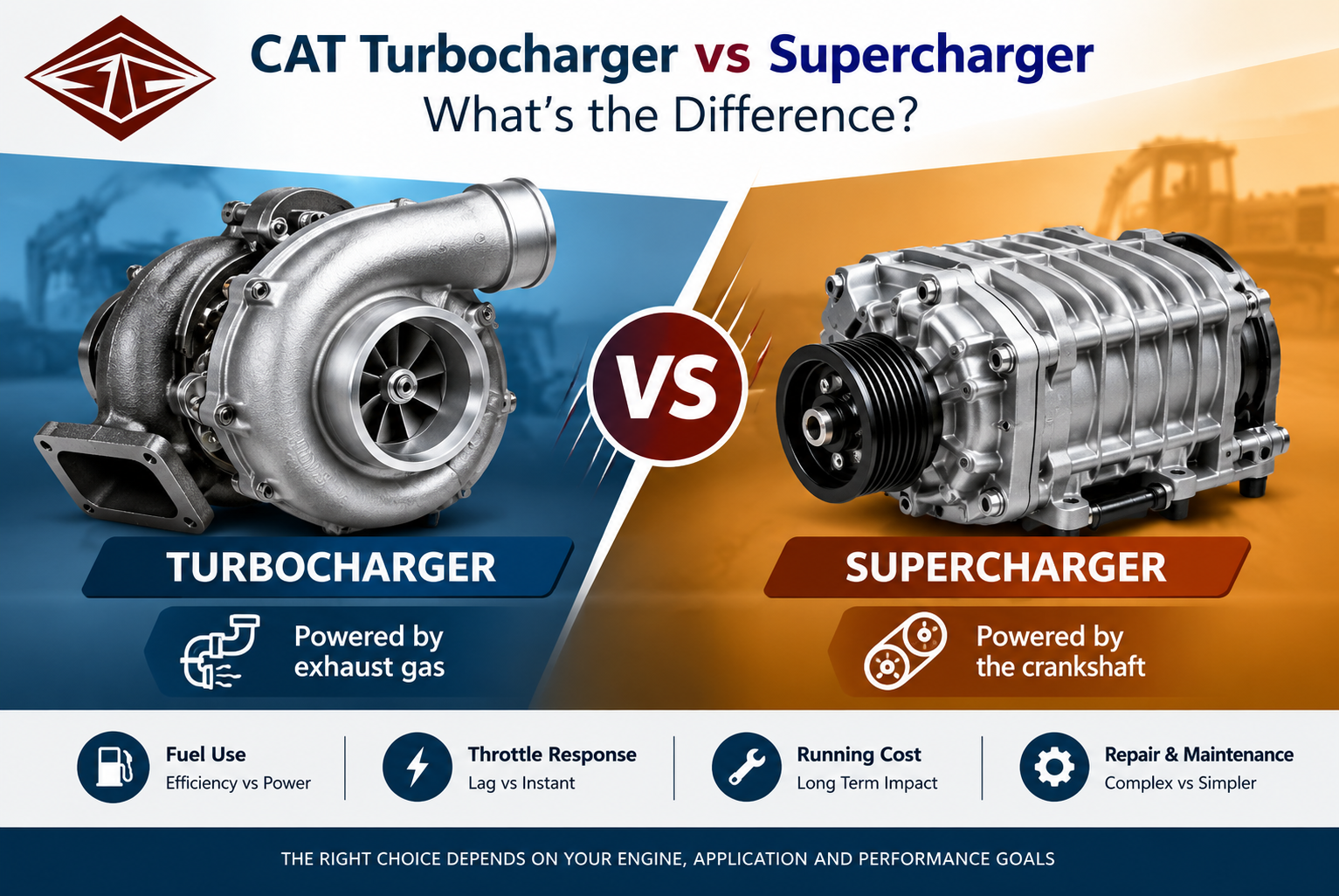
Here is the plain version. A turbocharger is driven by exhaust gas. A supercharger is driven by the engine’s crankshaft. Both push extra air into the engine, but they get their power from different places, and that one detail affects fuel use, throttle response, running cost, and repair bills.
This guide covers the difference between turbocharger and supercharger, why diesel engines favour turbos, and what that means if you run Caterpillar engines in excavators, generators, trucks, or marine vessels.
What is forced induction and why does it matter?
An engine makes power by burning fuel with air. If you can fit more air into each cylinder, you can burn more fuel and get more power from the same engine size.
A naturally aspirated engine just draws air in at normal atmospheric pressure. Forced induction squeezes that air first, so more oxygen fits into the same space. Turbochargers and superchargers are the two main ways of doing this. Both use a compressor. They only differ in what spins it.
How does a turbocharger work?
The turbocharger working principle is simple. Hot exhaust gas leaves the cylinders and hits a turbine wheel, making it spin. That turbine sits on a shaft connected to a compressor wheel on the other side. As the compressor spins, it pulls in fresh air and pushes it into the intake at higher pressure.
Nothing connects the turbo to the crankshaft. It runs on energy the engine would have thrown away through the exhaust. That is why turbos are seen as the more efficient option.
Larger Caterpillar engines sometimes use more than one turbo. The Cat C13 ACERT, for example, uses sequential twin turbochargers. A smaller unit helps at low load, and a larger one takes over as the engine works harder.
How does a supercharger work?
A supercharger compresses air in the same way, but a belt, chain, or gear set links it straight to the crankshaft. When the engine turns, the supercharger turns. There is no waiting for exhaust flow to build up.
Common designs include Roots, twin-screw, and centrifugal units. All of them take a share of engine power to run. You pay for instant boost with a little of the power you are trying to add.
Turbocharger vs supercharger: quick comparison
| Feature | Turbocharger | Supercharger |
|---|---|---|
| Power source | Exhaust gas | Crankshaft (belt, chain, or gear) |
| Boost at low RPM | Slower, needs exhaust flow | Immediate |
| Fuel efficiency | Better, uses waste energy | Lower, draws engine power |
| Operating heat | Very high, sits in the exhaust path | Lower, sits on the intake side |
| Oil and cooling needs | High, needs clean oil supply | Lower |
| Maintenance | More demanding | Simpler |
| Common use | Trucks, gensets, marine, earthmoving | Muscle cars, drag racing, some petrol engines |
What is turbo lag?
Turbo lag is the short pause between pressing the throttle and getting full boost. At low RPM there is not much exhaust flow, so the turbine takes a moment to speed up. A supercharger has no lag because it turns with the engine from the start.
On modern diesel machines, lag matters much less than it did years ago. Twin-turbo layouts, better turbine design, and smarter engine control have cut it down. Heavy equipment also works under steady load, so the delay rarely gets in the way of real work.
Why do diesel engines use turbochargers?
A diesel engine turbocharger is a natural fit for several reasons:
- No throttle plate. A diesel takes in a full cylinder of air on every stroke, so exhaust flow stays strong even at moderate load. That keeps the turbo spinning.
- Strong exhaust energy. Diesels under load push out plenty of hot gas, which gives the turbine steady power.
- Fuel cost. A supercharger drags on the engine all day. On machines that run long hours, that drag becomes a real fuel bill.
- No knock limit. Petrol engines struggle with knock as boost rises. Diesels don’t, so higher boost is easier to use.
You can supercharge a diesel, and some people do. But it costs efficiency and adds load, so most builders skip it. That is why CAT turbochargers show up across excavators, wheel loaders, dump trucks, generator sets, and marine propulsion engines.
Where the aftercooler fits in
Squeezing air makes it hot, and hot air is less dense. Less dense air carries less oxygen, which cuts into the gain you were after. An aftercooler cools the compressed air before it enters the cylinders, so you get the full benefit of the boost.
This matters when you replace a turbo. If the aftercooler is clogged, leaking, or damaged, the new turbo will not perform the way it should. Check both together.
Can you run both? Twin charging explained
Yes. Twin charging uses a supercharger at low RPM and hands over to a turbocharger as exhaust flow builds. It covers the weak spot of each part. But it adds cost, weight, and complexity, so you mostly see it in performance builds, not in industrial diesel engines.
Common myths
“A supercharger is just a bigger turbo.” No. The compressor idea is similar, but the drive is completely different.
“Turbos are free power.” Not quite. A turbo adds some back pressure in the exhaust, but the net gain is still better than running a belt-driven unit.
“CAT engines can use any turbo that fits.” They cannot. A close match is still a wrong match. Boost, flow, and housing all need to suit the engine.
“Turbo failure means a bad turbo.” Often the turbo is the victim. Oil starvation, dirty oil, and blocked air filters cause many failures.
Which one is right for your CAT engine?
For Caterpillar diesel engines, the turbocharger is the right answer in nearly every case. It matches how these engines are built and how they work under load.
The catch is fitment. A CAT turbocharger has to match your engine model, serial number prefix, emissions configuration, and the original part number. Keep these ready before you order:
- Engine model and serial number
- Existing turbocharger part number
- Type of machine (excavator, genset, marine, truck)
Quick decision guide
- Running heavy diesel equipment for long hours: turbocharger
- Want fuel savings on continuous load: turbocharger
- Building a petrol performance car with instant throttle: supercharger
- Need both low-RPM response and top-end power: twin charging
How to make a turbo last longer
You can add years to a turbo with a few habits:
- Use clean oil and change it on schedule. The turbo shaft runs on an oil film, so dirty oil wears it fast.
- Keep the air filter clean. Dust and grit damage compressor wheels quickly.
- Let the engine idle for a short time before shutdown after heavy work. This lets the turbo cool while oil still flows.
- Fix oil leaks and exhaust leaks early.
- Warm the engine before loading it in cold weather.
If your machine has lost power, is smoking more than usual, or has started whining, read our guide on CAT turbocharger failure before you spend money on a replacement.
Where to buy a genuine CAT turbocharger in India
STC Engineering (Shah Trade Corporation) has supplied Caterpillar parts from Mumbai since 1979. Our range covers Caterpillar turbochargers, installation kits, aftercoolers, and the cooling parts that often need attention along with a turbo. To see the machines these parts go into, browse our Caterpillar engines, or read the history of Caterpillar engines to see how the brand grew.
Send your engine model and part number to sales@stcengineering.in and our team will confirm the match. You can also browse our full range of Caterpillar spare parts.
Frequently asked questions
Which is better, a turbocharger or a supercharger?
It depends on the job. A turbocharger is more efficient and suits diesel engines. A supercharger responds faster and suits performance petrol engines.
Do diesel engines use superchargers?
Rarely. Almost all diesel engines, including Caterpillar engines, use turbochargers because of their efficiency and strong exhaust flow.
Which one uses less fuel?
The turbocharger. It runs on exhaust energy, while a supercharger draws power from the crankshaft.
What is turbo lag?
It is the short delay before a turbo builds full boost at low RPM. Modern diesel engines have reduced it a lot.
Can one engine have both?
Yes, this is called twin charging, but it is uncommon outside performance builds.
How do I know if my CAT turbocharger is failing?
Look for power loss, extra smoke, and a new whining noise. Our CAT turbocharger failure guide lists the signs and causes in detail.