

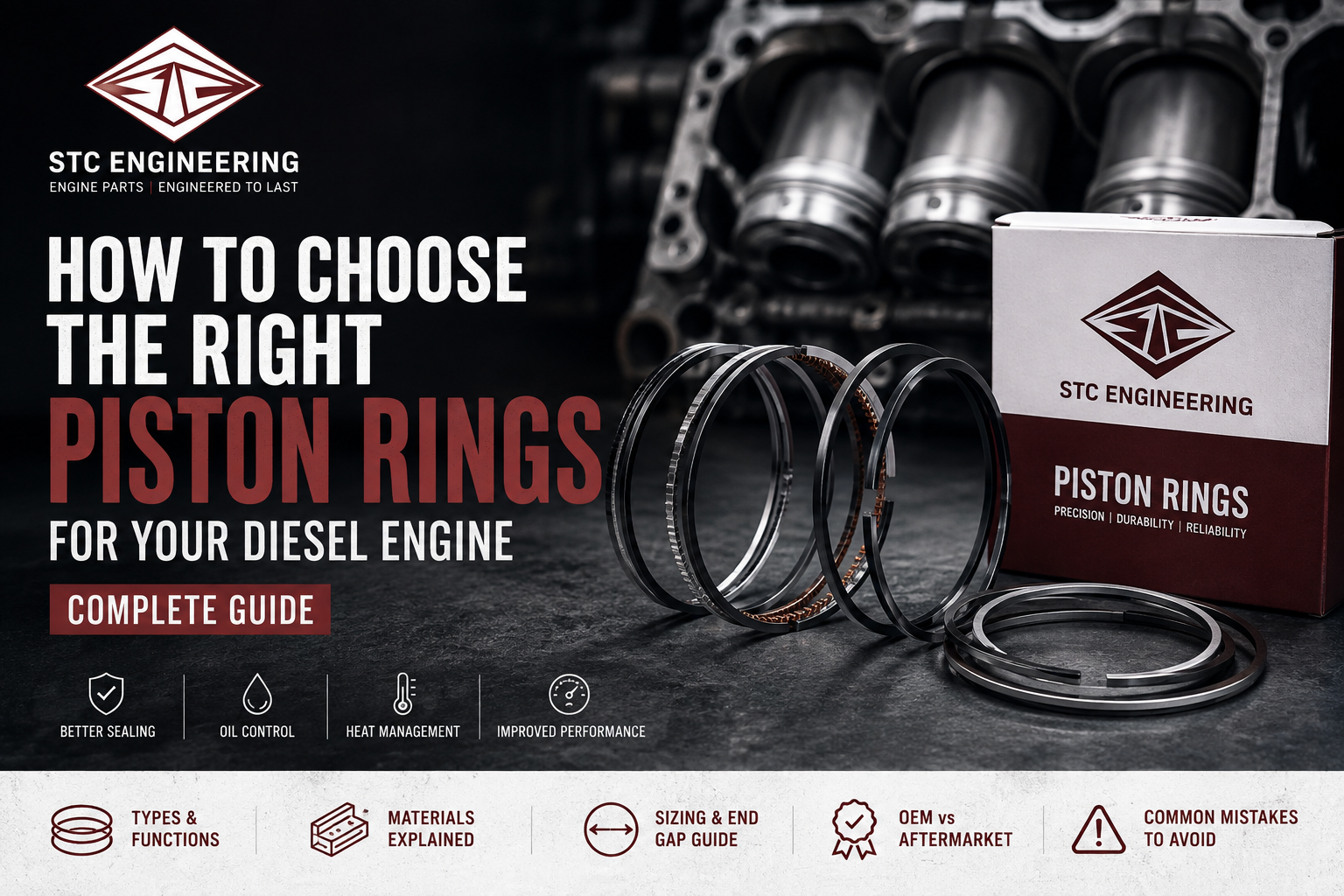
If you’ve ever rebuilt a diesel engine, you already know piston rings don’t get much attention until something goes wrong. They’re small, they’re cheap compared to the rest of the engine, and it’s tempting to just grab whatever set fits the bore and move on. But these little rings are doing three jobs at once inside your engine: sealing the combustion chamber, controlling how much oil reaches the cylinder wall, and pulling heat away from the piston. Get the wrong set, and you’ll usually find out the hard way, through lost power, smoky exhaust, or an engine that needs opening up again sooner than it should.
This guide walks through everything worth knowing before you buy: the different ring types, what they’re made of, how sizing and end gap actually work, and the mistakes we see most often when customers come to us after a rebuild hasn’t gone to plan.
1. What Piston Rings Actually Do
Most diesel pistons carry somewhere between two and five rings, and they fall into two broad groups.
Compression rings sit closer to the piston crown. Their job is to seal the combustion chamber and stop high pressure gases from slipping past the piston during combustion, something engine builders call blow by.
Oil control rings sit further down, below the compression rings. They manage how much oil reaches the cylinder wall, leaving just enough for lubrication while scraping the rest back down before it can burn off in the combustion chamber.
If a ring set fails at any one of these jobs, you’ll notice it fairly quickly, whether that’s through poor compression, blue smoke out the exhaust, or an engine running hotter than it should.
2. Types of Piston Rings in a Diesel Engine
Most diesel engines use a two to four ring setup, and each ring in that stack has its own role to play.
Top compression ring (fire ring): This sits in the groove closest to the combustion chamber and takes the brunt of the heat and pressure. It provides the main gas seal and is usually rectangular or barrel faced.
Second compression ring (napier or taper faced ring): This one backs up the top ring’s seal and also acts as a wiper, scraping oil off the cylinder wall as the piston moves down. The tapered face is what gives it that slight wiping action.
Oil control ring (scraper ring): Usually the lowest ring in the stack, often built as a three piece design with two steel rails and a spring expander in between. It scrapes the extra oil off the liner and sends it back to the crankcase, leaving just a thin film behind for the rings above.
Some heavy duty or higher output diesel engines run extra compression rings to cope with the added cylinder pressure. It’s always worth checking your engine’s original ring configuration before ordering a replacement set, rather than assuming a standard layout will match.
3. Matching Rings to Your Engine’s Application
Not every diesel engine puts the same stress on its rings, so it helps to think through a few things before choosing:
Engine type. Tractor, commercial vehicle, marine, industrial, and genset engines all run under different loads and at different temperatures.
Turbocharged vs naturally aspirated. A turbocharged engine runs higher cylinder pressures, so it needs rings built to handle that extra load without giving way.
Duty cycle. Engines that run continuously under heavy load, like gensets or marine engines, need more heat and wear resistant rings than engines that only run intermittently.
If you’re not sure which category your engine falls under, checking the OEM specifications or simply asking your parts supplier will save you from an expensive mismatch later.
4. Piston Ring Materials Explained
Piston rings are usually made from cast iron or steel, and often carry a surface coating for added protection.
Cast iron rings are the reliable, cost effective option and work well in standard diesel engines under normal conditions.
Steel rings come into play where ring height is low or where the engine experiences steep pressure gradients, which is common in modern high output diesels. Steel also has higher breaking strength, which matters for spacers and rails in three piece oil control rings.
Chrome or molybdenum coatings improve wear resistance and cut down friction, which is especially useful for engines that run long hours between services.
Phospho bronze, sintered iron, or sintered bronze show up in more specific applications, such as oil ring rails or situations where extra conformability against the liner is needed.
For most standard diesel rebuilds, a good quality cast iron ring with a wear resistant coating gives you the right balance of cost and durability. Where ring height is tight or pressures run high, steel is generally the better call.
One thing worth remembering: the ring material needs to be compatible with the cylinder liner material. Mismatched liner and ring materials lead to uneven, premature wear on one or both parts, so it’s best to pair rings and liners from the same product line wherever possible.
5. Ring Sizing and End Gap Clearance
This is where a lot of rebuilds go sideways, and getting these numbers right matters more than people often expect.
Bore match. Make sure the ring size matches your piston and cylinder liner bore precisely. Even a small mismatch, a fraction of a millimeter, will affect how well the ring seals.
End gap clearance. This is the small opening left in the ring to allow for heat expansion. As a rough starting point, always checked against the engine manufacturer’s own spec:
- Top compression ring: around 0.004 inches per inch of bore diameter (roughly 0.016 inch on a 4 inch bore)
- Second ring: a touch larger than the top ring, typically 0.005 inches per inch of bore
- Oil control ring: varies by design, so check the manufacturer’s chart for your specific ring
If the end gap is too tight, the ring can seize as it heats up and expands, which can score the cylinder wall. Too loose, and you lose compression while oil consumption creeps up.
Side clearance. This is the gap between the ring and its groove in the piston, checked with a feeler gauge. Too small and the ring can stick in the groove. Too large and it won’t seal as well as it should.
Cylinder taper check. Measuring the end gap at both the top and bottom of the liner tells you how much taper wear has built up in the bore. Any difference between those two readings points to wear that should be sorted out before new rings go in.
Groove and ridge inspection. Take a close look at the piston ring grooves for wear, and check for a ridge at the top of the liner bore. A new ring can catch on that ridge and get damaged the moment the engine starts if it isn’t removed first.
If you’re replacing rings without replacing the liner, measure your existing bore rather than assuming it still matches the original spec. Wear builds up over time, and those numbers can shift more than you’d expect.
6. Genuine vs Aftermarket Piston Rings
You don’t necessarily need OEM branded rings, but you do need rings that meet OEM tolerances. A few things worth checking:
- ISO or IATF certification from the manufacturer
- Clear documentation of material and coating specifications
- A supplier who can confirm the rings actually suit your exact engine model, not just a generic bore size match
Cheaper, unverified rings tend to cost more in the long run. Reduced compression, higher oil consumption, and having to do the job again all add up fast.
7. Common Buying Mistakes to Avoid
A few errors come up again and again when sourcing replacement rings:
Mixing new rings with old, worn ones. Always replace the full set together rather than just swapping the top ring.
Combining rings from different manufacturers. Tolerances vary between brands, and mixing them is one of the most common reasons a rebuild doesn’t seal properly.
Ignoring the liner’s condition. New rings fitted into a worn or tapered liner will wear out quickly and may never seal the way they should.
Skipping the end gap check before installation. Just because a ring is new doesn’t mean it’s correctly gapped for your bore. That still needs to be checked.
Getting the ring orientation wrong. Compression rings often have a marked top face, usually stamped “TOP,” and need to go in the right way up or they won’t seal properly.
Not staggering the end gaps. Ring end gaps should sit roughly 120 degrees apart around the piston. If they line up, it increases blow by.
Sourcing a matched piston, ring set, and liner from the same supplier, rather than mixing and matching from different places, gives you the best shot at a clean, long lasting seal.
8. Choosing the Right Rings: Quick Reference Table
| Check This | Why It Matters |
| Ring type and configuration | Determines gas sealing vs oil control balance |
| Engine type and duty cycle | Determines pressure and heat tolerance needed |
| Material (cast iron or steel) and coating | Affects durability and friction |
| Ring size and end gap | Directly affects sealing and compression |
| Side clearance | Prevents sticking or reduced sealing |
| Certification (ISO or IATF) | Confirms consistent quality and tolerances |
| Full set vs individual rings | Prevents uneven wear and poor sealing |
| Ring orientation and gap staggering | Prevents blow by and premature failure |
Frequently Asked Questions
How many piston rings does a diesel engine have? Most diesel pistons run two to four rings, usually two compression rings and one or two oil control rings, though some heavy duty or high output engines use extra compression rings to handle higher cylinder pressures. It’s always worth confirming the exact setup against your engine’s OEM spec rather than assuming.
What’s the difference between a compression ring and an oil control ring? A compression ring seals the combustion chamber and keeps high pressure gases from leaking past the piston. An oil control ring manages how much oil reaches the cylinder wall, scraping the excess back into the crankcase so it doesn’t burn off in the combustion chamber.
How do I know if my piston rings are worn out? Look out for blue tinted exhaust smoke, rising oil consumption, a drop in engine power or compression, and more blow by than usual (pressure escaping past the piston into the crankcase). A compression test or leak down test will confirm whether the rings are the problem.
Can I reuse old piston rings after a rebuild? It’s not a good idea. Rings wear unevenly over time and lose their sealing tension. Reusing them, even with a new piston or liner, usually leads to poor compression and higher oil consumption not long after the rebuild.
Do I need to replace the cylinder liner when I replace the piston rings? Not always, but it’s worth inspecting closely first. If you see scoring, taper wear, or a ridge at the top of the bore, replacing the liner alongside the rings will give you a better seal and a longer service life overall.
What’s the real difference between genuine and aftermarket piston rings? Genuine, or OEM, rings are made to the exact original spec by the engine manufacturer or an approved supplier. Aftermarket rings can match or even exceed OEM tolerances if they come from a certified manufacturer (ISO or IATF certified), but uncertified aftermarket rings often use inconsistent materials and tolerances, which tends to lead to earlier failure.
Need Help Choosing the Right Piston Rings?
At STC Engineering, we supply piston rings and complete ring sets built to match OEM tolerances across a wide range of diesel engine applications, from pistons and liners through to the full gasket and bearing sets that go with a complete overhaul. If you’re not sure which ring set fits your engine, get in touch with our team and we’ll help you match the right parts the first time.