

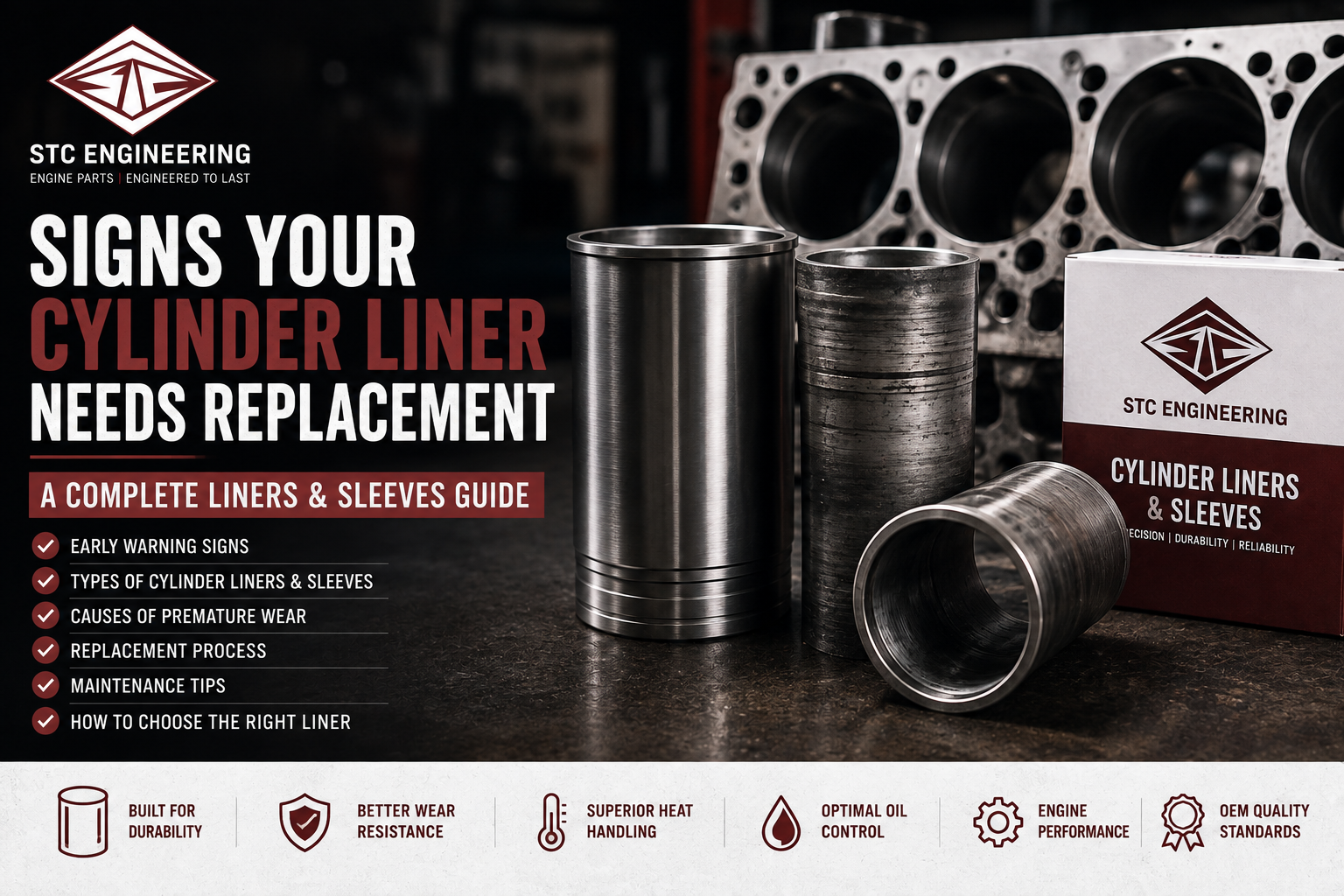
Cylinder liners, also called sleeves, don’t fail overnight. They wear down slowly, hour after hour, as the piston and piston rings ride against the liner wall on nothing more than a thin film of oil. None of that wear shows up from the outside. That’s exactly why so many engines get run far longer than they should before someone notices the liner is the actual problem, not the rings, not the pistons, but the liner itself.
This guide walks through how liners and sleeves wear, the warning signs to watch for, the different cylinder liner types you’ll come across, and how to choose the right replacement when the time comes.
1. What Liners and Sleeves Actually Do
A cylinder liner (or sleeve, the two terms are used interchangeably in most workshops) sits inside the engine block and forms the inner wall of the cylinder. It’s what the piston and piston rings actually move against, not the engine block itself. Without a liner or sleeve in place, the block would take all that wear directly, and blocks are expensive to replace or aren’t replaceable at all.
Liners and sleeves do three jobs at once. They give the piston a smooth, hard wearing surface to move on. They help withstand the pressure and heat generated during combustion. And depending on the type, they often play a role in cooling the engine too.
Because liners and sleeves are removable, a worn one can usually be swapped out on its own, without having to replace the entire engine block. That’s the whole point of using them in the first place.
2. Signs Your Cylinder Liner or Sleeve Needs Replacing
Here’s what to look and listen for.
Rising oil consumption. If you’re topping off oil more often than you used to, a worn cylinder liner is often the reason. As the liner wall loses its shape, the piston rings can’t seal against it properly, and oil starts working its way past the rings into the combustion chamber.
Blue or white smoke from the exhaust. Blue smoke usually points to oil getting into the combustion chamber and burning off. White smoke, especially after the engine has warmed up, can mean coolant is finding its way in through a cracked or pitted liner.
Loss of compression or engine power. A scored, pitted, or worn liner can’t hold a proper seal against the piston rings, even with brand new rings fitted. If you’ve already replaced the rings and you’re still seeing poor compression, the cylinder liner is very likely the real culprit.
Increased blow by. This is when combustion gases escape past the piston rings into the crankcase instead of staying in the combustion chamber. It’s one of the clearest signs that the liner wall is no longer providing a tight enough seal.
Hard starting or rough idling. A liner that’s lost its shape or picked up surface damage makes it harder for the engine to build and hold compression, which shows up as difficulty starting or an idle that isn’t smooth.
Visible scoring, pitting, or cracks. If you can get eyes on the liner itself during a strip down, deep scratches (scoring), small pitted holes, or hairline cracks are all clear signs it needs cylinder liner replacement, not just honing.
Uneven compression test readings. If one cylinder reads noticeably lower than the others on a compression test, that’s often a sign of excessive wear, scoring, or cracking in that particular liner or sleeve.
None of these signs on their own always means the liner is at fault, but if you’re seeing two or three of them together, it’s worth pulling the liner and taking a proper look rather than just replacing the rings and hoping for the best.
3. Types of Cylinder Liners and Sleeves
Liners and sleeves generally fall into three categories, and which one your engine uses affects how it’s replaced and what to look for during inspection.
Dry liners (dry sleeves). These sit inside the engine block without any direct contact with the coolant. The block itself handles the cooling around them. Dry liners and dry sleeves are generally easier to fit into an existing block, though heat dissipation isn’t quite as efficient as with wet liners.
Wet liners (wet sleeves). These are in direct contact with the engine coolant, essentially forming part of the cooling jacket themselves. Wet liners handle heat far more effectively, which is why they’re common in heavy duty diesel engines that run hard for long stretches. They do need proper sealing at the top and bottom of the liner, usually with O-rings or gaskets, to keep coolant from leaking into the crankcase or combustion chamber.
Flanged liners and sleeves. A flanged liner has a lip at the top that locks it in place in the bore, adding strength and helping prevent movement or lubricant leakage, particularly in aluminum blocks where the liner and block expand at different rates.
Finned (air cooled) liners. Less common outside specific applications, these use exposed fins in direct contact with the surrounding air to dissipate heat, rather than relying on liquid coolant.
If you’re not sure which type your engine uses, checking the OEM liner and sleeve specification before ordering a replacement will save you a lot of hassle at fitting stage.
4. Liner and Sleeve Materials Explained
Most cylinder liners and sleeves are made from cast iron, though steel is used in some higher performance or high wear applications.
Cast iron liners are the standard choice for heavy duty diesel engines. They’re durable, handle heat well, and have a long track record in industrial, agricultural, and commercial vehicle engines.
Steel liners and sleeves show up more in high performance builds where extra wear resistance is needed, though they come at a higher cost.
Whatever material you choose, it needs to be compatible with your piston rings. Mismatched ring and liner materials wear unevenly and shorten the life of both parts, so sourcing your rings, pistons, and liners as a matched set is always the safer route.
5. What Causes Premature Liner Wear
A few common culprits show up again and again when a liner or sleeve fails earlier than it should:
Poor cooling system maintenance. Corrosion inhibitors matter, even if you’re already running coolant. Plain water or poorly maintained coolant leads to pitting and rust on wet liners over time.
Piston slap. If a piston isn’t properly aligned inside the liner, it can repeatedly strike the liner wall, which scores the surface and accelerates wear.
Cavitation. Common in diesel engines due to vibration, cavitation causes tiny bubbles to form in the coolant around a wet liner. When those bubbles collapse, they slowly eat away at the liner surface, which is exactly how pinhole leaks form over time.
Low quality liners. Liners made from inferior alloys or without proper heat treatment are more prone to warping, cracking, and premature wear, regardless of how well the rest of the engine is maintained.
Short trip cycles and excessive idling. Engines that don’t get a chance to reach and hold proper operating temperature tend to see more cylinder wall wear over time.
6. How Cylinder Liner Replacement Actually Works
If you’ve never watched a liner replacement happen, it’s worth understanding the basic steps, even if you’re handing the job to a workshop. Knowing the process helps you ask the right questions and spot a rushed job before it costs you an engine.
Step 1: Strip down and inspect. The old liner is removed and the bore is thoroughly cleaned of dirt, old gasket material, and debris. This is also when the block itself gets inspected for damage that might affect how the new liner seats.
Step 2: Measure the bore. A bore gauge checks the cylinder bore’s diameter and roundness. This confirms whether you need a standard replacement liner or an oversized one to compensate for wear in the block.
Step 3: Prepare the sealing surfaces. For wet liners, new O-rings or sealing rings are always fitted at this stage, never reused from the old liner. Reusing old seals is one of the most common causes of early coolant leaks after a rebuild.
Step 4: Align and insert the liner. The liner is carefully aligned with the bore and pressed or dropped into place using a proper liner installer tool, not hammered in by hand. Going in tilted, or with uneven seating pressure, creates problems that often don’t show up until the engine has run for a while under thermal cycling.
Step 5: Torque and protrusion check. Correct torque settings on cylinder head bolts or hold-down plates matter more than most people expect, since incorrect torque affects how well the liner seats and seals. On many engines, liner protrusion (how far the top of the liner sits proud of the block deck) is measured at several points to confirm it falls within spec.
Step 6: Honing. New liners are typically given a light “touch hone” to create the right surface texture for new piston rings to seat against properly during break-in. This isn’t the same as the heavier honing used to correct a worn bore, it’s a finishing step for a brand new cylinder liner.
Step 7: Leak test and reassembly. Wet liners especially should be leak tested with a vacuum or pressure test kit before the engine is fully reassembled. From there, pistons, rings, and the head gasket go back in following the standard rebuild sequence.
Skipping steps here, especially bore measurement, correct torque, and protrusion verification, is exactly how a new liner ends up failing early. This isn’t a job to rush.
7. Cylinder Liner Maintenance Tips to Extend Service Life
A well-fitted liner can still wear out early if the engine around it isn’t looked after. A few habits go a long way:
Keep the cooling system in good condition. Always run proper coolant with corrosion inhibitors, not plain water, especially with wet liners. This single habit prevents the majority of pitting and cavitation damage.
Avoid excessive idling and short trips. Letting the engine reach full operating temperature regularly reduces cylinder wall wear over time.
Stick to scheduled oil changes. Clean oil protects the thin film between the piston rings and the liner wall, which is really all that’s standing between smooth operation and metal-on-metal wear.
Monitor oil consumption and exhaust color. Catching a small increase in oil use or a faint smoke color change early can mean the difference between a planned liner replacement and an unexpected engine failure.
Don’t ignore a failed compression test. If a compression test flags one cylinder as low, don’t just top up oil and hope it improves. Investigate before it turns into a bigger repair.
8. Choosing the Right Replacement Liner
When it’s time for cylinder liner replacement, a few things are worth checking before you order:
- Confirm whether your engine uses a wet, dry, or flanged liner, and match the replacement exactly. These aren’t generally interchangeable.
- Check the bore size and wall thickness against your engine’s OEM specification.
- Source your liner alongside matching pistons and rings where possible, rather than mixing suppliers, to avoid material or tolerance mismatches.
- Look for ISO or IATF certification, which points to consistent manufacturing tolerances.
- If you’re dealing with a wet liner, make sure new sealing O-rings or gaskets are fitted at the same time. Reusing old seals on a new liner is a common cause of early coolant leaks.
9. Quick Reference Table
| Sign or Factor | What It Usually Means |
| Rising oil consumption | Worn liner allowing oil past the rings |
| Blue exhaust smoke | Oil burning in the combustion chamber |
| White exhaust smoke | Coolant entering through a cracked or pitted liner |
| Loss of compression after new rings | Liner wall itself is worn or scored |
| Increased blow by | Liner no longer sealing properly against the rings |
| Uneven compression test readings | Wear, scoring, or cracking in a specific liner |
| Visible scoring or pitting | Liner needs replacement, not just honing |
Frequently Asked Questions
What’s the difference between a cylinder liner and a cylinder sleeve? In most workshops, liner and sleeve mean the same thing, a removable cylindrical component fitted into the engine block that forms the inner wall the piston moves against. Liners and sleeves are used interchangeably across the industry.
How do I know if I need a new liner or just new piston rings? If you’ve already replaced the piston rings and you’re still seeing poor compression, oil consumption, or blow by, the liner itself is very likely worn. Rings and liners wear together, so during any major overhaul it’s worth inspecting both rather than assuming new rings alone will fix the issue.
What’s the difference between a wet liner and a dry liner? A wet liner sits in direct contact with the engine coolant and forms part of the cooling jacket. A dry liner does not touch the coolant directly, relying on the surrounding engine block for cooling instead. Wet liners generally offer better heat dissipation, which is why they’re common in heavy duty diesel engines.
Can a cylinder liner be repaired instead of replaced? Minor wear can sometimes be corrected with honing, which restores the surface finish for new piston rings to seat against. But once wear, scoring, or pitting goes beyond acceptable tolerances, honing won’t be enough, and the liner needs to be replaced.
How long do cylinder liners and sleeves typically last? It depends heavily on engine type, duty cycle, and maintenance, but liners and sleeves are generally built to last for thousands of hours of running time. Poor cooling system maintenance, short trip cycles, and low quality liners are the most common reasons a liner wears out earlier than expected.
Do I need to replace all the cylinder liners at once, or just the worn one? If only one cylinder is showing signs of wear or a low compression reading, it’s usually fine to replace just that liner. That said, if the engine has run a long time on all its liners, it’s often more cost effective in the long run to replace the full set during a major overhaul rather than doing them one at a time.
Does a new cylinder liner need honing before use? Yes, in most cases. New liners typically get a light “touch hone” before assembly, which creates the right surface texture for new piston rings to seat against during break-in. This is different from the heavier honing used to correct an out-of-round or worn bore, and it’s a step that shouldn’t be skipped even on a brand new liner.
What tools are needed to replace a cylinder liner? A proper job needs more than just hand tools. Expect to use a bore gauge to check dimensions, a liner installer or press to seat the new liner without tilting it, a torque wrench for correct head bolt or hold-down plate torque, and a honing tool for surface preparation. Wet liners also need a vacuum or pressure leak test kit before final reassembly.
Need Help Choosing the Right Liners and Sleeves?
At STC Engineering, we supply cylinder liners and sleeves engineered to match OEM tolerances across a wide range of diesel engine applications, alongside matched pistons, piston rings, and bearings for a complete overhaul. If you’re not sure which liner or sleeve fits your engine, get in touch with our team and we’ll help you get the right parts the first time.