

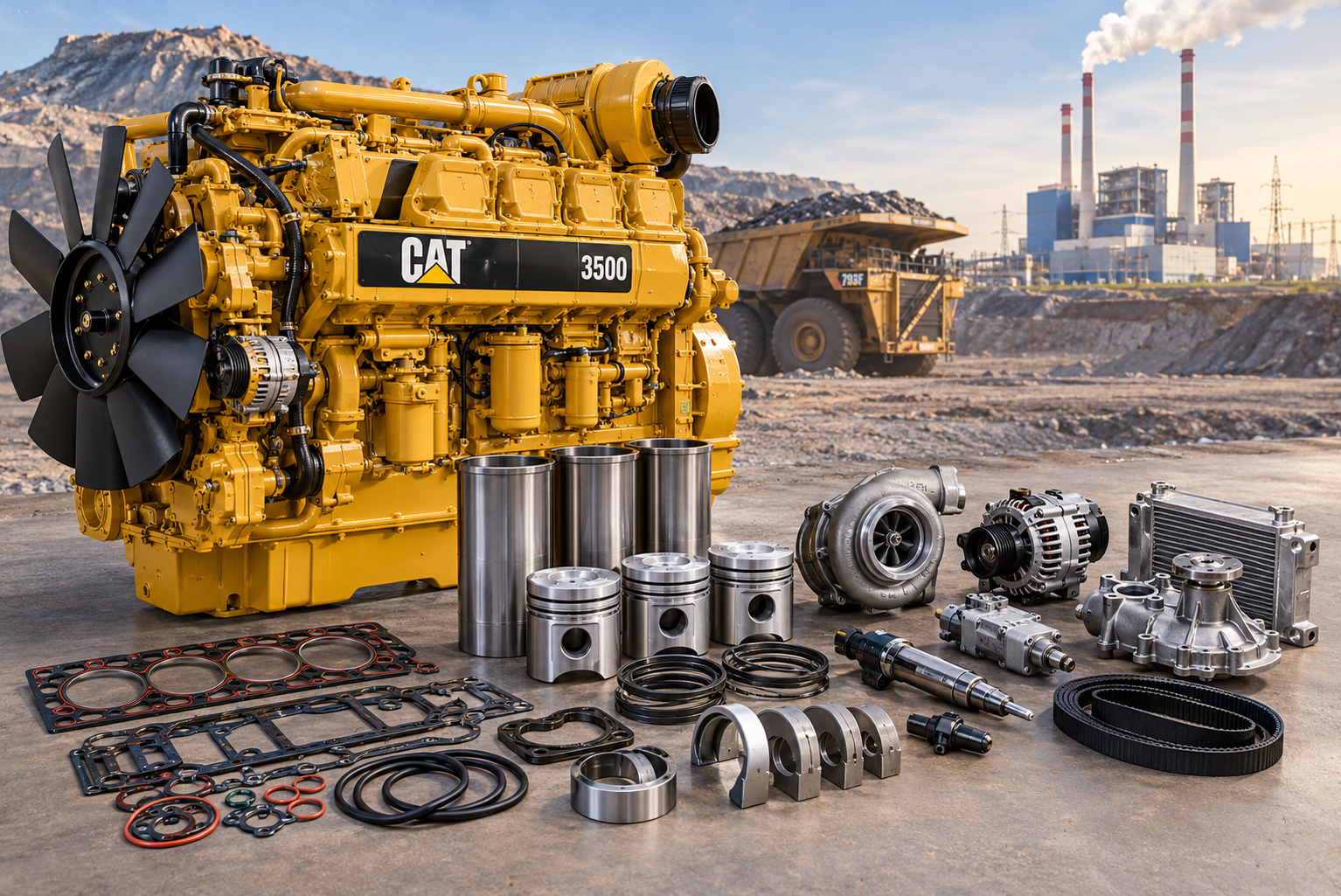
CAT 3500 series engine parts are the replacement components for Caterpillar’s V8, V12 and V16 diesel engines, the 3508, 3512 and 3516. In mining and power generation, the parts replaced most often are cylinder liners, pistons, bearings, cylinder heads, turbochargers, aftercoolers, fuel injectors and gasket sets. The safest way to order any of them is to match the engine serial number and arrangement number.
If you run a 3500 series engine, you already know it rarely quits on its own terms. These engines have been moving rock and carrying plant loads for decades, and plenty of them are on their second or third overhaul. That kind of life does not come from luck. It comes from the right part, fitted at the right time.
This guide covers what the 3500 series is, which parts wear first, how mining duty differs from power generation duty, and how to choose between genuine and aftermarket components without second guessing yourself later. We have supplied Caterpillar parts since 1979, so a lot of what follows comes from what customers actually ask us.
What is the CAT 3500 series?
Caterpillar built the 3500 series for off-highway trucks, and the 3512 was the first model released. The family later grew to include the 3508 (V8), 3512 (V12) and 3516 (V16), with larger versions such as the 3520 and 3524 following.
One design choice matters a lot for anyone buying parts. Each cylinder has its own head with four valves, so a mechanic can deal with one cylinder without pulling the whole top end apart. That makes repairs faster and it also means you can often buy a single head or a single liner instead of a full set.
| Model | Configuration | Where you often find it |
|---|---|---|
| CAT 3508 | V8 | Smaller gensets, drilling rigs, auxiliary power |
| CAT 3512 | V12 | Mid-size gensets, haul trucks, industrial drives |
| CAT 3516 | V16 | Large gensets, crusher power units, heavy mining equipment |
The same engines also turn up in marine work, which is one reason spares are easier to source than for many other engines of this size.
Why mining and power generation sites rely on it
Both industries ask the same thing of an engine: run hard, run long, and do it far from a workshop. A 3500 series engine handles that well because it is simple to service and the parts supply is deep. You can still find mechanical and electronic versions working side by side on the same site.
The catch is that hard duty is exactly what wears parts out. Knowing where to look first saves a lot of money.
CAT 3500 series engine parts that wear first
Not every component ages at the same speed. These are the groups we see ordered most often.
Power cylinder parts
Liners, pistons, rings and connecting rod bearings do the real work, so they take the real punishment. When blow-by rises, oil consumption climbs or compression drops, this is usually where the problem sits. Many operators buy a complete engine rebuild kit at this stage instead of piecing parts together, because it keeps clearances consistent across every cylinder.
Cylinder heads and valve train
Valves, seats, guides, rocker components and head gaskets all live in a hot, high-pressure zone. Burnt valves and worn guides show up as rough running, white smoke or power loss. Because each cylinder has its own head, you can replace only the ones that need it.
Fuel system
Injectors and fuel pumps are sensitive to dirty fuel. Poor atomization means more fuel burnt for less power, and eventually damaged pistons. If your fuel is stored for long periods or comes from mixed sources, expect to replace injectors sooner.
Air system
Turbochargers, aftercoolers and air filters decide how much clean air reaches the cylinders. A tired turbo or a blocked aftercooler pushes exhaust temperatures up and strains everything downstream.
Cooling and lubrication
Water pumps, oil pumps, oil coolers and thermostats rarely get attention until they fail. When they do, the damage spreads fast. Replacing them during a planned shutdown costs far less than replacing them after an overheating event.
Gaskets, seals and sensors
Cheap parts, expensive failures. A leaking seal or a lazy sensor can shut down a unit that is otherwise healthy, so keep a gasket set and a few key sensors on the shelf.
What mining duty does to a 3500 series engine
Mining is rough on engines in a few very specific ways. Dust is the biggest one. Fine particles get past tired air filters and wear liners and rings far faster than normal operation would. Heat comes next, since long shifts and heavy haul cycles keep cooling systems under constant pressure. Shock loads on slopes and in loading cycles add stress to bearings and mounts.
For mining operations, the practical lessons are simple. Change air filters before the restriction gauge tells you to, test coolant regularly, and keep an eye on oil analysis results. A rising silicon reading usually points to an air intake problem long before the engine starts to complain.
What power generation duty does to a 3500 series engine
A generator set has a very different life. Prime power units run for long stretches at steady load, which is easy on the engine but puts hours on every wear part. Standby units sit idle most of the time, and the risk shifts to starting reliability, old coolant, weak batteries and stale fuel.
One issue is common on both. Running a diesel at light load for too long can leave unburnt fuel in the exhaust system, often called wet stacking, and it shortens injector and turbo life. For power generation sites, matching the load to the engine rating and running regular load tests is the cheapest protection you can buy.
Genuine or aftermarket CAT 3500 engine parts?
There is no single right answer, and anyone who tells you otherwise is selling something. Genuine parts make sense for critical components, warranty work and engines still under a service agreement. Quality aftermarket parts can make sense for older engines and for items where the price gap is large and the risk is low.
The real danger is not aftermarket itself. It is unknown quality. Ask for material and manufacturing details, ask where the part was made, and ask what support you get if something goes wrong. STC Engineering supplies a mix of genuine and aftermarket parts, and we will tell you plainly which one we would choose for your engine and duty.
How to order the right part the first time
Wrong parts cost more than money. They cost shutdown time. A few habits prevent most mistakes.
Start with the engine serial number and the arrangement number from the data plate. Different builds of the same model can use different parts, so the model name alone is not enough. Use the parts book to confirm the part number, and send photos if you are unsure. If a number has been superseded, ask your supplier to confirm the replacement before it ships.
It also helps to know the full range of Caterpillar engines your site runs. Many sites mix a 3500 series with smaller C series or 3400 series units, and keeping one organized parts list across all of them avoids mix-ups.
Maintenance habits that reduce parts spending
The cheapest part is the one you never have to replace early. Oil analysis catches wear metals, fuel dilution and coolant leaks before they become failures. Clean filters and fresh coolant protect liners and bearings. Written service records let you see patterns, like one cylinder that always runs hot.
It also pays to plan overhauls instead of reacting to breakdowns. A structured preventive maintenance program lets you order parts in advance, schedule shutdowns around production, and avoid emergency freight.
Choosing a supplier for CAT 3500 series parts
Price matters, but it should not be the first filter. Look at stock depth, lead time, documentation and whether someone will pick up the phone when your engine is down at two in the morning.
Our warehouse in Mumbai covers more than 25,000 square feet, and we hold a wide range of CAT 3500 series engine parts alongside components from other trusted brands used in heavy engines. If you already have your serial number and part list, you can request a quote for CAT 3500 series engine parts and our team will reply with availability and lead time.
Frequently asked questions
Which engines are in the CAT 3500 series?
The main models are the 3508 (V8), 3512 (V12) and 3516 (V16). Larger versions such as the 3520 and 3524 also belong to the family.
Which CAT 3500 series engine parts wear out first?
Liners, piston rings, bearings, fuel injectors and turbochargers usually wear first, followed by water pumps, oil coolers and gaskets. The order shifts with duty, fuel quality and how well the air and cooling systems are maintained.
Can I use aftermarket parts on a CAT 3500 series engine?
Yes, many operators do, especially on older engines. Choose a supplier who can document quality and stand behind the part, and keep genuine parts for the most critical components.
How do I find the correct part number?
Use the engine serial number and arrangement number from the data plate, then confirm the part number in the parts book. If you are unsure, send a photo and the serial number to your supplier before ordering.
How often should a 3500 series engine be overhauled?
There is no single hour count that fits every engine. It depends on duty, power rating and maintenance quality. Most operators plan overhauls from oil analysis trends, compression and blow-by readings, and the service guidance for their specific serial number.
Are CAT 3500 series engines still supported?
Yes. The family is still widely used, and older mechanical and electronic versions are kept running through genuine, aftermarket and remanufactured parts.
Final thoughts
A 3500 series engine rewards operators who pay attention. Know which parts wear first, match your maintenance to your duty cycle, order by serial number, and work with a supplier who understands the engine. Do that, and these engines will keep earning long after most people would have written them off.