

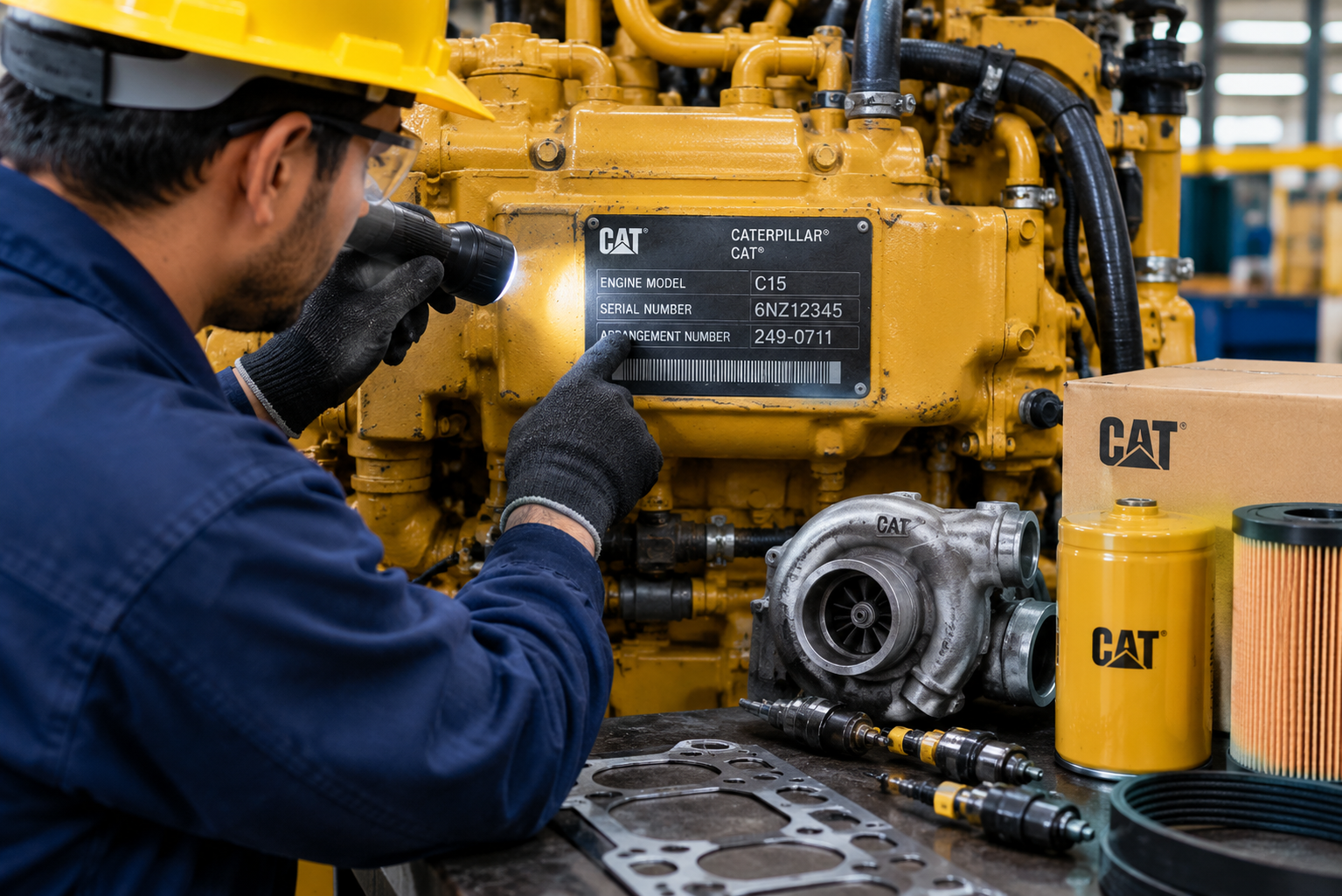
To identify the correct Caterpillar spare parts, find the engine serial number on the engine data plate, note the prefix and the digits, and record the arrangement number if one is shown. Give these to your parts supplier or enter them in Caterpillar’s parts system, then confirm the part number against the correct serial number range before you order.
Ordering the wrong part is one of the most expensive small mistakes in heavy engine maintenance. The part looks right, the box says Caterpillar, and then it does not fit. Now the engine is down, the freight is paid twice, and someone is asking who made the call.
Almost every one of those mistakes can be avoided with one piece of information, the engine serial number. This guide shows how to read it, where to find it, and how to use it to pick the right parts, whether your engine sits in a haul truck, a generator set or a crusher plant.
We have supplied Caterpillar spare parts since 1979, and the first question we ask on almost every enquiry is the same. What is the serial number?
Why the engine model alone is not enough
Two engines can carry the same model name and still use different parts. Caterpillar updates designs during a model’s life, so injectors, turbochargers, cooling parts, electronics and ratings can change from one build to the next. A 3512 built in one year may not share every component with a 3512 built years later.
The engine serial number tells the parts system exactly how your engine was built at the factory. That is why a parts book often lists components against a serial number range instead of a model name alone.
This matters most on larger Caterpillar engines, where a single engine can run for many thousands of hours and go through more than one overhaul. By the second rebuild, nobody remembers what was changed the first time, but the serial number still knows.
What a Caterpillar engine serial number looks like
Before you start searching, it helps to know what you are looking for. People often send us casting numbers, part numbers or machine numbers by mistake, simply because they are not sure what an engine serial number should look like.
The serial number prefix
A Caterpillar engine serial number begins with a three character serial number prefix made of letters and numbers, followed by a run of digits. The prefix points to the engine model and a particular build family. For example, the prefix 6NZ is commonly linked to a single turbo C15 engine.
You need both parts. The digits without the prefix are not enough, and neither is the prefix without the digits.
The arrangement number
Many Caterpillar engine plates also show an arrangement number. It is usually written as three digits, a hyphen and four digits. It identifies the specific engine configuration and the group of parts the engine was built with.
When the parts system asks for it, supply it. When two parts look alike on paper, the arrangement number often settles which one is correct.
Serial number, machine PIN and generator set number
These numbers get mixed up all the time, so keep them apart. The engine serial number identifies the engine. A machine PIN identifies the whole machine, such as a haul truck or a loader. A generator set usually has its own plate with a set serial number, while the engine carries a separate plate of its own.
For engine parts, always use the number from the engine plate.
Where to find the engine serial number
Look for a metal data plate fixed to the engine, commonly near the valve cover or on the side of the block. The exact position changes from model to model, so check your engine manual or ask your dealer if you cannot spot it. Many Caterpillar engines also have the serial number stamped into the block itself, which helps when the plate is missing.
Once you find the plate, wipe off the oil and dust, use a torch to cut the glare, and take a clear photo straight on. A photo is more reliable than copying digits by hand, especially when the plate is worn.
How to identify the correct Caterpillar spare parts step by step
The process is the same whether you are ordering a gasket set or a full rebuild kit. Follow the steps in order and you will avoid most of the usual problems.
Step 1: Find and photograph the data plate
Locate the plate, clean it and photograph it clearly. Keep the photo, because your supplier may ask for it later.
Step 2: Record the prefix, digits and arrangement number
Write down the full engine serial number exactly as shown, including the prefix. Add the arrangement number and the engine model. Read each character twice, because a number five and the letter S can look alike on a worn plate.
Step 3: Look the engine up in the parts system
Your Cat dealer or parts supplier can enter the serial number into Caterpillar’s parts tools, which return the exact build of your engine. This is the step that turns a general model name into a specific engine.
Step 4: Find the part in the right diagram and serial range
Open the correct group, such as fuel system, air system or lubrication, and find the part on the diagram. Check the note beside it. Many parts are listed as applying up to a certain serial number or from a certain serial number onward, so make sure your engine falls inside the range.
Step 5: Check for supersessions
Part numbers get replaced over time. A supersession means an older number has been replaced by a newer one, sometimes with changes to how the part fits or works. Ask whether the new part is a direct replacement or whether it needs extra items such as new gaskets, bolts or a kit.
Step 6: Confirm with your supplier before ordering
Send your supplier the serial number, the arrangement number and the part number you found, then ask them to confirm the match. A good supplier will check it again on their side and flag anything that looks off. STC Engineering supplies genuine and aftermarket Caterpillar parts and checks every enquiry against the engine serial number before quoting.
Common mistakes that lead to wrong parts
Most wrong orders come from the same small slips.
- Ordering by engine model only, without the serial number
- Giving the machine PIN or the generator set number instead of the engine serial number
- Sending a casting number from the part instead of a part number
- Misreading a worn plate, especially letters that look like numbers
- Ignoring the serial number range printed next to the part in the parts book
- Missing a supersession and ordering an outdated number
- Forgetting that the engine may have been modified or replaced in the field
The last one catches people more often than you might expect, and it leads into the next problem.
What to do if the data plate is missing or unreadable
Plates get painted over, damaged or lost during repairs and engine swaps. Do not guess. Look for the serial number stamped into the engine block, check the maintenance records and old purchase invoices, and ask your Cat dealer whether they hold a record for the engine.
If none of that works, send your supplier clear photos of the engine from several sides, along with the old part you want to replace. A good parts specialist can often narrow it down, but expect them to confirm dimensions and fitment before shipping anything.
Extra checks for mining and power generation engines
Heavy duty sites have a few extra traps, because engines there get rebuilt, swapped and moved more often than most.
Mining equipment
In mining, an engine may have been exchanged for a remanufactured unit, or moved from one machine to another. Do not assume the plate on the machine matches the engine inside it. Always read the serial number from the engine currently installed, and update your records whenever an engine changes.
Generator sets
For power generation equipment, remember that the generator set plate and the engine plate are different. Use the engine plate for engine parts. Also note the rating and the application, since engines used in standby, prime or continuous duty can be set up differently.
Keeping serial number records saves time later
The easiest way to avoid this whole search next time is to keep a simple record for every engine on site. Store the serial number, arrangement number, a photo of the plate, the date of each overhaul and the part numbers used. A structured preventive maintenance program makes this routine, because the engine details are already on file when the next service comes around.
What to send your supplier
The more complete your enquiry, the faster and more accurate the reply. Send the following where you can.
- Engine serial number with prefix
- Arrangement number
- Engine model and the application, such as a generator set or a haul truck
- Part name, and the part number if you already have it
- A photo of the data plate
- A photo of the old part
- Quantity and delivery location
If you have these ready, you can request Caterpillar spare parts from our team and we will reply with the correct match, availability and lead time.
Frequently asked questions
Where is the engine serial number on a Caterpillar engine?
It is usually on a metal data plate fixed to the engine, commonly near the valve cover or on the side of the block. The position varies by model, and many engines also have the number stamped into the block.
What is the difference between the serial number and the arrangement number?
The engine serial number identifies your individual engine, while the arrangement number identifies the configuration and the group of parts it was built with. Suppliers often need both to confirm the right part.
Can I find a Caterpillar part number using only the serial number?
Not directly. The serial number identifies the engine, and then you pick the part you need from the parts book for that engine. You still have to know which component you are replacing.
Can I order Caterpillar spare parts without the serial number?
For simple items it may be possible, but it is risky. Using the serial number is the safest way to avoid wrong parts, delays and return freight.
What should I do if a part number has been superseded?
Ask your supplier whether the new number is a direct replacement and whether it needs extra parts such as gaskets, bolts or a kit. Do not assume the old and new parts fit in exactly the same way.
Does the serial number tell me the year the engine was built?
Not in a simple way. Unlike a car VIN, a Caterpillar serial number does not carry an obvious year code. Your Cat dealer can look up the build date from the serial number.
Final thoughts
A few minutes spent finding and reading the engine serial number can save days of delay and a lot of money. Photograph the plate, record the prefix, digits and arrangement number, check the serial range and supersession, and confirm with a supplier who knows Caterpillar engines. Do that every time, and the right part will be the one that arrives.